
Dec 17, 2025
Modern medicine offers us extraordinary tools: blood tests, advanced imaging (MRI, CT), genetic testing, clinical evaluations, and medical records documenting our entire health history.
Modern medicine offers us extraordinary tools: blood tests, advanced imaging (MRI, CT), genetic testing, clinical evaluations, and medical records documenting our entire health history. And yet… far too often, this information remains separated — each piece stored in a different system, a different database, a different file. A test result in one place, a scan in another, medical history on another platform, and the genome — if it even exists — untouched.
So when the real patient sits in front of the physician, only a fragment of the story is visible.
The consequences are profound:
• diagnoses are made on fragments of information, not the full picture
• many diseases are detected only when symptoms become evident
• treatments are frequently standardized, not truly personalized
• medical research progresses slowly — with high costs and many failures
• continuity of care is weak — because data does not communicate with data
And perhaps most importantly:
Medicine often ends up treating symptoms, not causes.
Not out of negligence.
But because the real causes stay hidden — lost between isolated pieces of data.
Now imagine a world where all these elements — tests, imaging, DNA, complete history — are integrated into a single health picture.
A world where diagnosis happens early, treatment is tailored to the individual, and prevention becomes the rule, not the exception.
👉 This is no longer just a vision.
This is the promise of Multimodal AI — the technology capable of repairing fragmentation so medicine can finally see the whole human being.
What is Multimodal AI?
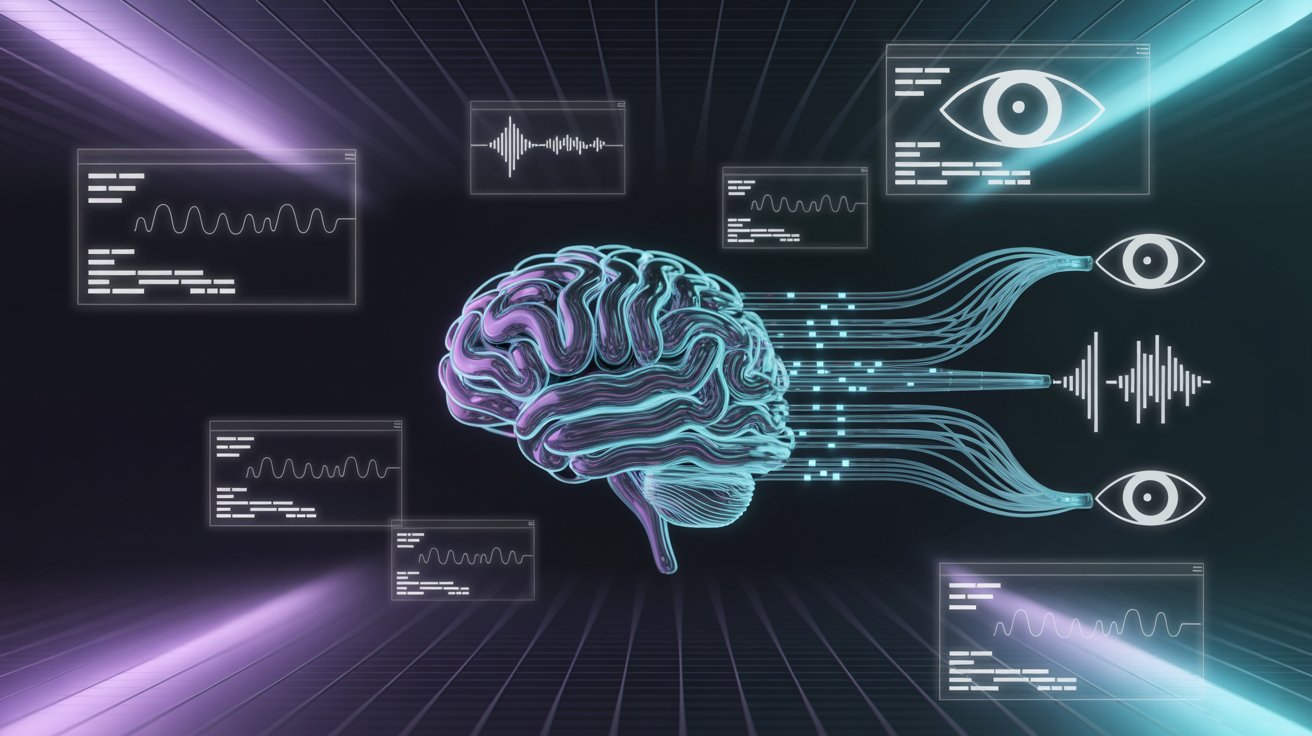
Multimodal AI represents a new generation of artificial intelligence, capable of analyzing and correlating very different types of medical data simultaneously — imaging (MRI, CT, X-ray), laboratory results, genetic information, clinical records, and physiological signals from continuous monitoring. Instead of viewing these data in isolation, this technology builds a unified and coherent representation of the patient.
Acting as an advanced layer of integration, multimodal AI can uncover subtle biological relationships — patterns impossible to detect when each data category is analyzed separately. This fundamentally changes how we understand disease mechanisms — from cancer to cardiometabolic or neurodegenerative disorders.
Multimodal AI has moved beyond the purely experimental stage. Multimodal models are already being tested and deployed in advanced research centers, leading hospitals, and pilot programs across the pharmaceutical industry — especially in areas where integrated data can directly influence clinical decisions.
Multimodal models are already used in:
● AI-assisted medical imaging — algorithms evaluate images together with clinical data to improve early detection of pathological changes and predict disease progression.
● Oncology and precision medicine — integrating genetic, histological, and imaging data enables more accurate therapy selection and identification of patients most likely to respond to specific treatments.
● Drug discovery and research — multimodal simulations drastically reduce the time needed to validate candidate molecules and increase the success rate in preclinical development.
● Preventive medicine and chronic disease management — combined analysis of lifestyle, biomarkers, and medical history enables proactive risk assessment and early intervention, before the disease becomes clinically visible.
The defining advantage of multimodal AI is its ability to replicate how an excellent physician reasons — not by focusing on a single detail, but by understanding the full context of a patient’s health. The difference is that AI can do this at a scale impossible for the human mind — and without losing critical details.
Multimodal AI is the infrastructure that can fundamentally transform medicine: from a reactive system, intervening only when disease is already present — to a predictive and preventive system, capable of identifying causes long before they become symptoms.
However, Multimodal AI is not yet deployed in everyday clinical practice. Current implementations remain limited to specialized centers, clinical studies, and tightly controlled pilot programs. While the potential is significant, large-scale adoption still depends on technology maturation, data standardization, and resolving the ethical and operational challenges that come with integrating this level of complexity into clinical workflows.
Limitations, Risks, and Ethical Dilemmas in Multimodal AI
Although Multimodal AI promises remarkable progress, its implementation in medicine comes with significant challenges. In many cases, these limitations are not technical — but rooted in data quality, transparency, accountability, and the protection of patient rights.
2.1. Data Quality — the Foundation Everything Is Built On
AI systems are only as good as the data they receive.
If part of the data is incomplete, inaccurate, or poorly harmonized — the entire output can be compromised.
• Imaging may come from different equipment and protocols
• Lab results may follow variable standards
• Genetic data may be missing or inconsistently interpreted
• Medical histories are often fragmented and uncorrelated
🔍 Studies in AI-assisted imaging already demonstrate these issues: models perform excellently in the clinic where they were trained but fail when applied to new populations or different equipment.
In Multimodal AI, this problem becomes amplified — because the sources are far more diverse and sensitive.
2.2. Clinical Validation and Accountability
A prediction is only a starting point.
To become a clinical decision, it must be:
• rigorously tested in clinical trials
• replicated across diverse cohorts
• supported by strong biological evidence
Without validation, there is a real risk of turning statistical correlations into medical conclusions — with potentially harmful consequences.
And a critical question remains: who is responsible for a decision made using AI?
The clinician? The model developer? The software provider?
The regulatory framework is still evolving — there are no definitive legal standards yet regarding responsibility for AI-assisted clinical decisions. However, in current medical practice and ethical standards, the final decision must always remain with the physician. AI can highlight risks, suggest hypotheses, and accelerate analysis — but it cannot replace clinical judgment, human context, or the professional accountability of medical care.
2.3. Explainability and Trust
Multimodal AI relies on complex models — often perceived as “black boxes.”
For clinicians to trust recommendations, systems must:
• show why a decision was made
• highlight which data contributed most
• allow verification of internal logic
Without explainability, there is a risk of blind dependence on algorithms — or, on the contrary, total rejection.
2.4. Ethics, Privacy, and Equity
Multimodal AI combines some of the most sensitive data categories: genetic, clinical, imaging, behavioral.
This raises major concerns:
• Who has access to this data?
• How is real, informed consent obtained?
• Can patients be re-identified even after anonymization?
• Will all patients benefit — or only those in top-tier hospitals?
The risk is that technology could amplify existing inequalities instead of reducing them.
2.5. Overconfidence and Overpromising
Enthusiasm can outrun reality.
Multimodal AI is not a universal solution, nor does it guarantee a perfect diagnosis or cure.
A mature healthcare system must treat AI as a powerful tool — not a final authority.
Multimodal AI opens the path toward smarter and more personalized medicine.
But its very complexity turns every step — from data collection to therapeutic recommendation — into a potential point of failure.
For this technology to truly deliver on its promise, we must invest in:
• data standardization and interoperability
• algorithmic transparency and accountability
• solid regulation
• practical, contextual ethics — not theoretical principles
Only then can Multimodal AI become a real support for physicians and patients — not just a technological promise.
What Comes Next for Multimodal AI
Multimodal AI has the potential to transform medicine — not just in theory, but in practice: enabling early diagnosis, personalizing treatment, supporting real prevention, and integrating all patient information into a single, complete picture. But this transformation will not happen automatically.
For Multimodal AI to become a reliable, useful, and responsible tool, we must ensure:
• significant investment in data standardization, interoperability, and digital infrastructure
• clear and transparent rules for privacy, consent, and data governance
• rigorous clinical validation, replication across diverse cohorts, and possibly longitudinal studies
• development of explainable and auditable models, so decisions can be verified and understood by clinicians
• legal clarity: who is accountable when AI is wrong — the physician, the institution, or the developer?
• a firm ethical commitment: AI must remain a tool — not an authority — and the final decision must always belong to the physician
If we succeed in pairing technology with responsibility, Multimodal AI can deliver real change: shifting healthcare from reaction to prevention, from “treating symptoms” to “understanding causes.” Medicine can become more human, more precise, and more personalized — but only if we never lose sight of the human being behind the data.
📚 References:
npj Digital Medicine (Nature) — 2025
https://www.nature.com/articles/s41746-025-01992-6Full-text version (PMC)
https://pmc.ncbi.nlm.nih.gov/articles/PMC12107984/ResearchGate — AI medical imaging ethics
https://www.researchgate.net/publication/396147322_Navigating_Challenges_and_Ethical_Considerations_in_AI-Driven_Medical_Image_Analysis_A_Comprehensive_Analysis